This site is for U.S. Healthcare Professionals Only
This site is for U.S. Healthcare Professionals Only

The first and only FDA-Approved Oral Solution of
atomoxetine hydrochloride for adult and pediatric
patients 6 years of age and older

Treatment with an oral solution that does not
require compounding prior to administration
Calibrated dosing syringe with clear dose indicators
allows for administration of medication as
prescribed
Discover a ready-to-use oral solution option for the treatment of attention-deficit/hyperactivity
disorder (ADHD) in adults and pediatric patients 6 years of age and older

Oral solution of atomoxetine hydrochloride capsule now available

AtoncyTM Oral Solution may be an option for patients with difficulty swallowing capsules

Liquid formulation that does not require compounding prior to administration

Supplied with a calibrated oral syringe which may allow measured dose adjustments as prescribed
AtoncyTM (atomoxetine hydrochloride) Oral Solution is a selective norepinephrine reuptake inhibitor indicated for the treatment of ADHD in adults and pediatric patients 6 years of age and older.
Please click here for full Prescribing Information including BOXED WARNING and Medication Guide.
The first and only FDA-Approved Oral Solution of atomoxetine hydrochloride for adults and
pediatric patients 6 years of age and older with ADHD

Atoncy™ is the first and only oral solution of atomoxetine hydrochloride approved by the FDA for the treatment of ADHD in adult and pediatric patients 6 years of age and older

Ready-to-use oral solution formulation makes Atoncy™ Oral Solution caregiver-friendly

The oral solution offers an alternative formulation for some patients who find it challenging to swallow capsules
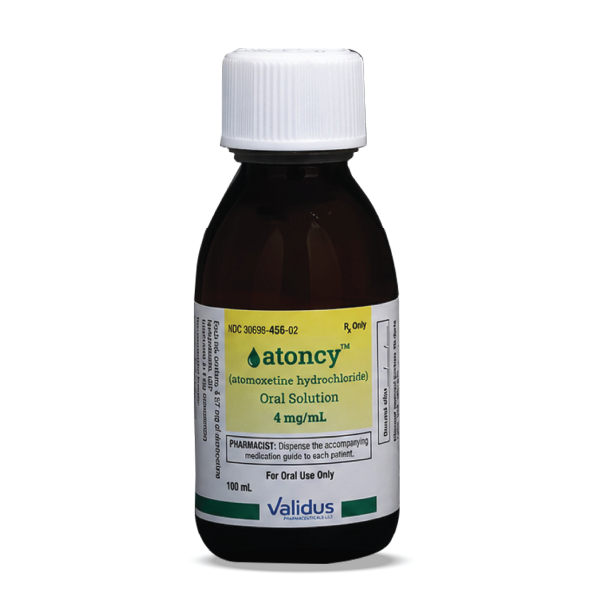

Atoncy™ Oral Solution is formulated to be stored at controlled room temperature 68°F to 77°F (20°C to 25°C)

AtoncyTM Oral Solution allows for prescribed dosing modification without physically manipulating the medication

A ready-to-use grape flavored oral solution with calibrated dosing syringe
Atoncy™ is the first and only oral solution of atomoxetine hydrochloride approved by the FDA for the treatment of ADHD in adult and pediatric patients 6 years of age and older
Ready-to-use oral solution formulation makes Atoncy™ Oral Solution caregiver-friendly
The oral solution offers an alternative formulation for some patients who find it challenging to swallow capsules
Atoncy™ Oral Solution is formulated to be stored at controlled room temperature 68°F to 77°F (20°C to 25°C)
AtoncyTM Oral Solution allows for prescribed dosing modification without physically manipulating the medication
A ready-to-use grape flavored oral solution with calibrated dosing syringe
FDA-approved medications versus compounded drugs: the key differences

*Not all compounders are registered with the FDA; therefore, compounding is dependent on whether the product is compounded at a facility that meets the conditions of section 503A of the Food, Drug, and Cosmetic Act
or an outsourcing facility.
• No Opening
• No Mixing
• No Guesswork

• No Opening
• No Mixing
• No Guesswork


| Age and Body Weight | Starting Dosage | Titration Interval | Target Dosage | Maximum Dosage |
|---|---|---|---|---|
| Pediatric patients who weigh less than 70 kg | 0.5 mg/kg/day | Minimum of 3 days | 1.2 mg/kg/daya,b | 1.4 mg/kg/day or 100 mg/day, whichever is lessa |
| Pediatric patients who weigh 70 kg or more and adult patients | 40 mg/day | Minimum of 3 days | 80 mg/daya | 100 mg/daya,c |
aAdministered either as a single daily dose in the morning or as evenly divided doses in the morning and late afternoon/early evening. bNo additional benefit has been demonstrated with atomoxetine dosages higher than 1.2 mg/kg/day. cIf a patient has not achieved an optimal response at 80 mg/day after 2 to 4 additional weeks, may increase dosage to a maximum of 100 mg/day. There are no data that support increased effectiveness at a dosage higher than 100 mg/day. Dosage and titration intervals may vary in patients with hepatic impairment or those receiving strong CYP2D6 inhibitors. See Full Prescribing Information for complete dosing recommendations
AtoncyTM Oral Solution Dose Conversion Calculator
Convert AtoncyTM Oral Solution dose from mg to mL with precision
Advise your patients to read the Instructions
for Use before starting Atoncy™ Oral Solution
and each time they receive a refill, as new
information may be available. This information
does not replace discussions with you about
your patients’ condition or treatment.
Please click here for full Prescribing
Information including BOXED WARNING
and Medication Guide.
The safety of ATONCY has been established from adequate
and well-controlled studies of atomoxetine capsules
in patients 6 years of age and older with ADHD.
The most common adverse reactions (≥5% and at least
twice the incidence of placebo patients) observed in clinical
trials were:
Please click here for full Prescribing Information including BOXED WARNING and Medication Guide.
Actor potrayals.
Actor potrayals.
The safety of ATONCY has been established from adequate and well-controlled studies of atomoxetine capsules in patients 6 years of age and older with ADHD.
The most common adverse reactions (≥5% and at least twice the incidence of placebo patients) observed in clinical trials were:
Please click here for full Prescribing Information including BOXED WARNING and Medication Guide
All pediatric patients 6 years of age and older treated with ATONCY should be monitored and observed closely for suicidal thoughts and behaviors, clinical worsening, or unusual changes in behavior, especially during the initial months of therapy or at times of dosage changes. Families and caregivers should be advised of the need for close observation and communication with the health care provider. Consider stopping ATONCY in patients who experience emergent suicidal thoughts and behavior.
ATONCY (atomoxetine) increased the risk of suicidal ideation in pediatric patients 6 years of age and older with attention-deficit/hyperactivity disorder (ADHD) in short-term studies.
ATONCY is a selective norepinephrine reuptake inhibitor indicated for the treatment of attention-deficit/hyperactivity disorder (ADHD) in adult and pediatric patients 6 years of age and older. ATONCY is indicated as an integral part of a total treatment program for ADHD that may include other measures (psychological, educational, social) for patients with ADHD.
At least 14 days must elapse between discontinuation of monoamine oxidase inhibitor (MAOI) antidepressant and initiation of ATONCY.
ATONCY is contraindicated in patients:
• With known hypersensitivity to ATONCY or other components of ATONCY. Hypersensitivity reactions that occurred with ATONCY use includes anaphylaxis, angioneurotic edema, urticaria, and rash.
• Taking, or within 14 days of stopping, a monoamine oxidase inhibitor.
• With narrow angle glaucoma. In clinical trials, ATONCY use was associated with an increased risk of mydriasis.
• With pheochromocytoma or a history of pheochromocytoma. Serious reactions, including elevated blood pressure and tachyarrhythmia.
• With severe cardiac or vascular disorders whose condition would be expected to deteriorate with clinically important increases in blood pressure or heart rate.
All pediatric patients 6 years of age and older treated with ATONCY should be monitored and observed closely for suicidal thoughts and behavior, clinical worsening, or unusual changes in behavior, especially during the initial months of therapy or at times of dosage changes, either increases or decreases. Consider changing the therapeutic regimen, including stopping ATONCY, in patients who experience emergent suicidality or symptoms that might be precursors to emerging suicidal thoughts and behavior, especially if these symptoms are severe or abrupt in onset, or were not part of the patient's presenting symptoms.
ATONCY should be discontinued and not restarted in patients with jaundice or laboratory evidence of liver injury.
Prior to ATONCY treatment, patients should have a careful history and physical exam to assess for presence of cardiovascular (CV) disease. ATONCY generally should not be used in pediatric patients with known serious cardiac abnormalities, cardiomyopathy, serious arrhythmias. Consideration should be given to not using ATONCY in adults with clinically significant cardiac abnormalities. Patients who develop symptoms such as exertional chest pain, unexplained syncope, or other symptoms suggestive of cardiac disease during atomoxetine treatment should stop ATONCY and undergo a prompt cardiac evaluation.
ATONCY is contraindicated in patients with severe cardiac or vascular disorders whose condition would be expected to deteriorate if they had a clinically important increase in blood pressure or heart rate. Heart rate and blood pressure should be measured at baseline, following ATONCY dosage increases, and periodically while on therapy to detect possible clinically important increases in heart rate and blood pressure.
If psychotic or manic symptoms occur, consider discontinuing ATONCY. Psychotic symptoms (e.g., hallucinations, delusional thinking), manic symptoms (e.g., mania) even in patients without a prior history of psychotic illness or mania can be caused by ATONCY even at the recommended dosage.
Before initiating treatment with ATONCY, patients should be adequately screened for risk factors for bipolar disorder such as personal or family history of mania and depression. Patients with bipolar disorder or risk factors for bipolar disorder may be at increased risk of developing mania or mixed episodes during treatment with ATONCY.
Patients initiating treatment with ATONCY should be monitored for the appearance or worsening of aggressive behavior or hostility.
ATONCY is contraindicated in patients with a known hypersensitivity reaction to ATONCY or other components of ATONCY. Although uncommon, hypersensitivity reactions, including anaphylaxis, angioneurotic edema, urticaria, and rash, have been reported in atomoxetine-treated patients.
Urinary retention or urinary hesitancy may occur.
Prompt medical attention is required in the event of suspected priapism in ATONCY-treated patients.
Closely monitor growth (e.g., weight, height) in pediatric patients during ATONCY treatment.
See Full Prescribing Information for additional warnings and precautions associated with ATONCY.
Most common adverse reactions:
• Nausea, vomiting, fatigue, decreased appetite, abdominal pain, and somnolence in pediatric patients.
• Constipation, dry mouth, nausea, decreased appetite, dizziness, erectile dysfunction, and urinary hesitation in adult patients.
See Full Prescribing Information for additional adverse reactions associated with ATONCY.
• Concomitant use contraindicated.
• With concomitant use of ATONCY and strong CYP2D6 inhibitors, increase the titration intervals.
• Increase the frequency of monitoring blood pressure and adjust ATONCY dosage as clinically appropriate.
• Increase the frequency of monitoring blood pressure and heart rate. See Full Prescribing Information for additional potential drug interactions associated with ATONCY.
• There is a pregnancy exposure registry that monitors pregnancy outcomes in women exposed to ADHD drugs, including ATONCY, during pregnancy. Atomoxetine use in pregnant women are insufficient to establish a drug associated risk of major birth defects, miscarriage, adverse maternal or fetal outcomes.
• There are no data on the presence of atomoxetine or its metabolite in human milk, the effects on the breastfed child, or the effects on milk production. Atomoxetine is present in animal milk. When a drug is present in animal milk, it is likely that the drug will be present in human milk. The developmental and health benefits of breastfeeding should be considered along with the mother's clinical need for ATONCY and any potential adverse effects on the breastfed child from atomoxetine hydrochloride or from the underlying maternal condition.
• The safety and effectiveness of ATONCY for the treatment of ADHD have been established in pediatric patients 6 years of age and older. Anyone considering the use of ATONCY in a pediatric patient must consider the associated risks and benefits with the clinical need. The safety and effectiveness of ATONCY in pediatric patients less than 6 years of age have not been established.
• The safety, efficacy and pharmacokinetics of atomoxetine in geriatric patients have not been evaluated.
• Compared with patients with normal hepatic function, atomoxetine exposure was increased in patients with moderate and in patients with severe hepatic impairment. The recommended dosage in patients with moderate or severe hepatic impairment is lower than in patients with normal hepatic function.
• The recommended titration interval is longer in CYP2D6 poor metabolizers than other CYP2D6 metabolizer types. Atomoxetine plasma concentrations were higher in CYP2D6 poor metabolizers which may increase the risk of atomoxetine-related adverse reactions. In pediatric and adult patients, the mean heart rate was higher in CYP2D6 poor metabolizers compared to other CYP2D6 metabolizer types.
• The most commonly reported symptoms with acute and chronic overdoses of atomoxetine were gastrointestinal symptoms, somnolence, dizziness, tremor, and abnormal behavior. Hyperactivity and agitation have also been reported. Signs and symptoms consistent with mild to moderate sympathetic nervous system activation (e.g., tachycardia, blood pressure increased, mydriasis, dry mouth) have also been observed. Most events were mild to moderate. In some cases of overdose involving atomoxetine, seizures have been reported. Less commonly, there have been reports of QT prolongation and mental changes, including disorientation and hallucinations.
• If an overdose occurs, consider contacting the Poison Help line (1-800-222-1222) or a medical toxicologist for additional overdose management recommendations. Because atomoxetine is highly protein-bound, dialysis is not likely to be useful in the treatment of overdose of ATONCY.
ATONCY is available as a 4 mg/mL oral solution.
To report SUSPECTED ADVERSE REACTIONS, contact Validus Pharmaceuticals LLC at 1-866-982-5438 or FDA at 1-800-FDA-1088 or www.fda.gov/medwatch
Please see Full Prescribing Information at atoncy.com
ATO-001-26
WARNING: SUICIDAL THOUGHTS AND BEHAVIORS IN PEDIATRIC PATIENTS 6 YEARS OF AGE AND OLDER
ATONCY (atomoxetine) increased the risk of suicidal ideation in pediatric patients 6 years of age and older with attention-deficit/hyperactivity disorder (ADHD) in short-term studies.
All pediatric patients 6 years of age and older treated with ATONCY should be monitored and observed closely for suicidal thoughts and behaviors, clinical worsening, or unusual changes in behavior, especially during the initial months of therapy or at times of dosage changes. Families and caregivers should be advised of the need for close observation and communication with the health care provider. Consider stopping ATONCY in patients who experience emergent suicidal thoughts and behavior.
ATONCY (atomoxetine) increased the risk of suicidal ideation in pediatric patients 6 years of age and older with attention-deficit/hyperactivity disorder (ADHD) in short-term studies.
ATONCY is a selective norepinephrine reuptake inhibitor indicated for the treatment of attention-deficit/hyperactivity disorder (ADHD) in adult and pediatric patients 6 years of age and older. ATONCY is indicated as an integral part of a total treatment program for ADHD that may include other measures (psychological, educational, social) for patients with ADHD.
At least 14 days must elapse between discontinuation of monoamine oxidase inhibitor (MAOI) antidepressant and initiation of ATONCY.
ATONCY is contraindicated in patients:
• With known hypersensitivity to ATONCY or other components of ATONCY. Hypersensitivity reactions that occurred with ATONCY use includes anaphylaxis, angioneurotic edema, urticaria, and rash.
• Taking, or within 14 days of stopping, a monoamine oxidase inhibitor.
• With narrow angle glaucoma. In clinical trials, ATONCY use was associated with an increased risk of mydriasis.
• With pheochromocytoma or a history of pheochromocytoma. Serious reactions, including elevated blood pressure and tachyarrhythmia.
• With severe cardiac or vascular disorders whose condition would be expected to deteriorate with clinically important increases in blood pressure or heart rate.
All pediatric patients 6 years of age and older treated with ATONCY should be monitored and observed closely for suicidal thoughts and behavior, clinical worsening, or unusual changes in behavior, especially during the initial months of therapy or at times of dosage changes, either increases or decreases. Consider changing the therapeutic regimen, including stopping ATONCY, in patients who experience emergent suicidality or symptoms that might be precursors to emerging suicidal thoughts and behavior, especially if these symptoms are severe or abrupt in onset, or were not part of the patient's presenting symptoms.
ATONCY should be discontinued and not restarted in patients with jaundice or laboratory evidence of liver injury.
Prior to ATONCY treatment, patients should have a careful history and physical exam to assess for presence of cardiovascular (CV) disease. ATONCY generally should not be used in pediatric patients with known serious cardiac abnormalities, cardiomyopathy, serious arrhythmias. Consideration should be given to not using ATONCY in adults with clinically significant cardiac abnormalities. Patients who develop symptoms such as exertional chest pain, unexplained syncope, or other symptoms suggestive of cardiac disease during atomoxetine treatment should stop ATONCY and undergo a prompt cardiac evaluation.
ATONCY is contraindicated in patients with severe cardiac or vascular disorders whose condition would be expected to deteriorate if they had a clinically important increase in blood pressure or heart rate. Heart rate and blood pressure should be measured at baseline, following ATONCY dosage increases, and periodically while on therapy to detect possible clinically important increases in heart rate and blood pressure.
If psychotic or manic symptoms occur, consider discontinuing ATONCY. Psychotic symptoms (e.g., hallucinations, delusional thinking), manic symptoms (e.g., mania) even in patients without a prior history of psychotic illness or mania can be caused by ATONCY even at the recommended dosage.
Before initiating treatment with ATONCY, patients should be adequately screened for risk factors for bipolar disorder such as personal or family history of mania and depression. Patients with bipolar disorder or risk factors for bipolar disorder may be at increased risk of developing mania or mixed episodes during treatment with ATONCY.
Patients initiating treatment with ATONCY should be monitored for the appearance or worsening of aggressive behavior or hostility.
ATONCY is contraindicated in patients with a known hypersensitivity reaction to ATONCY or other components of ATONCY. Although uncommon, hypersensitivity reactions, including anaphylaxis, angioneurotic edema, urticaria, and rash, have been reported in atomoxetine-treated patients.
Urinary retention or urinary hesitancy may occur.
Prompt medical attention is required in the event of suspected priapism in ATONCY-treated patients.
Closely monitor growth (e.g., weight, height) in pediatric patients during ATONCY treatment.
See Full Prescribing Information for additional warnings and precautions associated with ATONCY.
Most common adverse reactions:
• Nausea, vomiting, fatigue, decreased appetite, abdominal pain, and somnolence in pediatric patients.
• Constipation, dry mouth, nausea, decreased appetite, dizziness, erectile dysfunction, and urinary hesitation in adult patients.
See Full Prescribing Information for additional adverse reactions associated with ATONCY.
Concomitant use contraindicated.
With concomitant use of ATONCY and strong CYP2D6 inhibitors, increase the titration intervals.
Increase the frequency of monitoring blood pressure and adjust ATONCY dosage as clinically appropriate.
Increase the frequency of monitoring blood pressure and heart rate.
See Full Prescribing Information for additional potential drug interactions associated with ATONCY.
There is a pregnancy exposure registry that monitors pregnancy outcomes in women exposed to ADHD drugs, including ATONCY, during pregnancy. Atomoxetine use in pregnant women are insufficient to establish a drug associated risk of major birth defects, miscarriage, adverse maternal or fetal outcomes.
There are no data on the presence of atomoxetine or its metabolite in human milk, the effects on the breastfed child, or the effects on milk production. Atomoxetine is present in animal milk. When a drug is present in animal milk, it is likely that the drug will be present in human milk. The developmental and health benefits of breastfeeding should be considered along with the mother's clinical need for ATONCY and any potential adverse effects on the breastfed child from atomoxetine hydrochloride or from the underlying maternal condition.
The safety and effectiveness of ATONCY for the treatment of ADHD have been established in pediatric patients 6 years of age and older. Anyone considering the use of ATONCY in a pediatric patient must consider the associated risks and benefits with the clinical need. The safety and effectiveness of ATONCY in pediatric patients less than 6 years of age have not been established.
The safety, efficacy and pharmacokinetics of atomoxetine in geriatric patients have not been evaluated.
Compared with patients with normal hepatic function, atomoxetine exposure was increased in patients with moderate and in patients with severe hepatic impairment. The recommended dosage in patients with moderate or severe hepatic impairment is lower than in patients with normal hepatic function.
The recommended titration interval is longer in CYP2D6 poor metabolizers than other CYP2D6 metabolizer types. Atomoxetine plasma concentrations were higher in CYP2D6 poor metabolizers which may increase the risk of atomoxetine-related adverse reactions. In pediatric and adult patients, the mean heart rate was higher in CYP2D6 poor metabolizers compared to other CYP2D6 metabolizer types.
The most commonly reported symptoms with acute and chronic overdoses of atomoxetine were gastrointestinal symptoms, somnolence, dizziness, tremor, and abnormal behavior. Hyperactivity and agitation have also been reported. Signs and symptoms consistent with mild to moderate sympathetic nervous system activation (e.g., tachycardia, blood pressure increased, mydriasis, dry mouth) have also been observed. Most events were mild to moderate. In some cases of overdose involving atomoxetine, seizures have been reported. Less commonly, there have been reports of QT prolongation and mental changes, including disorientation and hallucinations.
If an overdose occurs, consider contacting the Poison Help line (1-800-222-1222) or a medical toxicologist for additional overdose management recommendations. Because atomoxetine is highly protein-bound, dialysis is not likely to be useful in the treatment of overdose of ATONCY.
ATONCY is available as a 4 mg/mL oral solution.
To report SUSPECTED ADVERSE REACTIONS, contact Validus Pharmaceuticals LLC at 1-866-982-5438 or FDA at 1-800-FDA-1088 or www.fda.gov/medwatch
Please see Full Prescribing Information at atoncy.com
ATO-001-26
The information contained in this site is intended for U.S. Healthcare Professionals only.
Click "OK" to confirm that you are a U.S. Healthcare Professional.
By clicking "Accept Cookies," you agree to the storing of cookies on your device to enhance the site navigation, analyze site usage, and assist in our marketing efforts.
Please fill out the form below and our representative will reach out to you soon.